Here’s the short answer. On the Gold Coast, a retaining wall needs building approval if any of these apply:
- it’s 1 metre or higher
- it holds up a load such as a driveway or shed
- it sits within 1.5 metres of a building or another wall
- it has a fence on top that brings the combined height to 2 metres or more
If you’ve been searching for retaining wall council approval Gold Coast, those are the rules that matter most. They come from Queensland’s Building Regulation 2021 and City of Gold Coast’s own checklist.
A few other things can trigger approval too, like sewer pipes, easements and waterfront setbacks. This guide walks you through each one, who signs off your wall, what the application needs and how long it takes.
When a Gold Coast Retaining Wall Doesn’t Need Building Approval
Your wall is exempt only if it’s under the 1 metre height threshold and meets every other condition City of Gold Coast lists. If it fails even one, you need approval.
| Condition | What it means for you |
| Less than 1.0 metre high | Measured at the tallest point, including the soil it holds back |
| More than 1.5 metres from a building or another retaining wall | Tiered walls placed close together don’t qualify |
| Holds back soil only | No surcharge such as a driveway, shed, pool or footing above it |
| Not part of pool fencing | Pool barrier walls always need approval |
| Wall and fence combined under 2.0 metres | A fence on top counts toward the height |
| Not built over a sewer or stormwater service | Check where your pipes run before you dig |
| Meets structural requirements | It still has to be built properly |
| Not in an easement or covenant area | Check your title and survey plan |
| Meets earlier development conditions | Estate rules from the original subdivision still apply |
| Not in a waterfront or oceanfront setback area | Common on canal and beachfront lots |
Exempt means you don’t need paperwork. It doesn’t mean anything goes: the wall still has to be built well and drained properly.
Who Gives Council Approval for a Retaining Wall in Queensland?
In Queensland, a private building certifier issues building approval for a retaining wall, not the council. So when people talk about council approval or a building permit, they usually mean building approval from a certifier. The certifier checks your design against the Queensland Development Code and the Building Regulation 2021.
Walls over 1 metre, or walls carrying a load, generally need a design from a Registered Professional Engineer of Queensland (RPEQ). Your certifier will ask for those drawings before approving anything. For a statewide look at height limits, licensing and penalties, see our guide to retaining wall approval in QLD.
Walls Near Sewer and Stormwater Pipes
Council does step in directly here. City of Gold Coast owns the local sewer, water and stormwater pipes, so building near them falls under QDC MP1.4. Your certifier can assess many of these cases, but some have to be referred to council. If the wall sits inside a council easement, you also need council’s consent through its build within easement (BOSE) request. Order a sewer location check early, because finding a pipe halfway through excavation is an expensive surprise.
What Else Triggers Approval Besides Height?
Height is only one test. A surcharge load, a fence on top, a waterfront setback, estate rules and drainage can each push a wall into approval territory, even when it’s well under 1 metre.
Surcharge: The Load Above Your Wall
Surcharge means any extra weight sitting behind or above the wall, such as a driveway, car parking, a shed, a pool or a house footing. A 700 millimetre wall holding up a driveway needs approval, because it has to resist far more than soil.
Height is measured at the highest point. Here’s something we see all the time: a homeowner plans a “900 millimetre wall”, but the yard falls away and the far end finishes at 1.3 metres. That one end decides whether you need approval.
Fences count. A 1.8 metre fence on a 400 millimetre boundary wall takes you over the 2.0 metre combined limit.
Waterfront lots have extra setbacks. If you’re on a canal in Broadbeach Waters, Sorrento or Hope Island, or right on the beach, check the waterfront and oceanfront setback areas first.
New estates have their own rules. Many estates in Coomera, Pimpama and Pacific Pines have plans of development or covenants that limit what you can build.
Stormwater has to go to the kerb. Council requires runoff to be piped to the kerb or the stormwater system, never onto your neighbour’s land, and it recommends a 600 millimetre side boundary setback. Local conditions matter here: heavy summer storms and clay soils in the hinterland test walls hard. Poor drainage is the main reason walls fail, so read up on retaining wall drainage before you build.
How to Get Building Approval for a Retaining Wall in Queensland
Getting approval is straightforward when you do things in the right order and have your documents ready. If your wall needs retaining wall council approval on the Gold Coast, the usual steps are:
- Check City Plan’s interactive mapping for overlays, easements and estate conditions.
- Order a sewer and stormwater location check.
- Have an RPEQ engineer design the wall, including footings and drainage.
- Lodge the application with a building certifier, who refers anything to council if needed.
- Build to the approved plans, with inspections along the way.
What Documents Your Application Needs
Your certifier will usually ask for:
- a site plan showing the wall, the boundaries and any sewer or stormwater lines
- the engineer’s drawings and design certificate
- drainage details
- council’s consent if the wall is in an easement or near its pipes
On a straightforward wall, design and approval typically take two to six weeks, and council referrals add more time. If you can, start in winter or spring, so the wall is finished before the summer storm season. Hillside blocks in Mudgeeraba, Bonogin and Currumbin Valley often need extra site investigation. Our guide to retaining walls on slopes explains why.
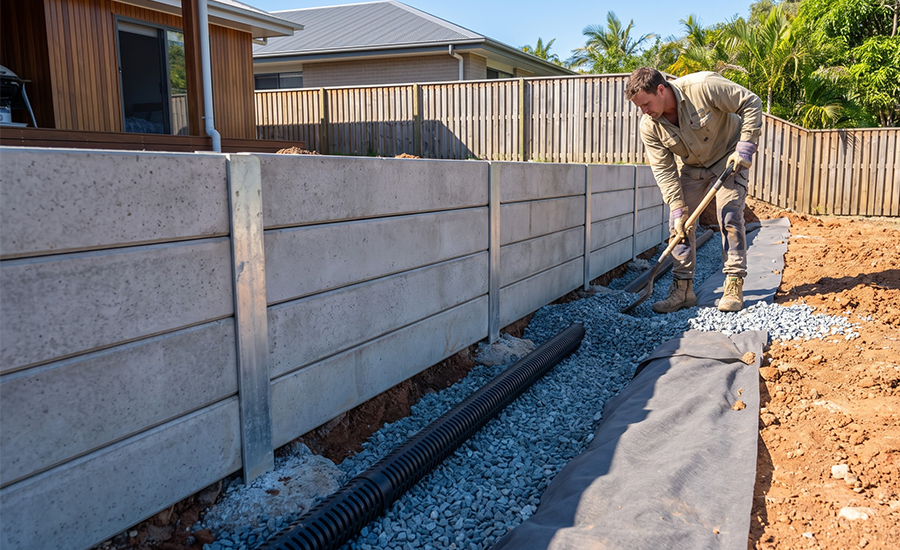
DIY or Hire a Professional?
A low garden wall on flat ground is a reasonable DIY job. Anything close to the 1 metre threshold, carrying a load or near services needs a professional.
| Situation | DIY suitable? |
| Garden edging wall under 500 mm, flat site, no load | Often yes |
| Wall approaching 1 metre or on a slope | Get professional advice |
| Wall over 1 metre, carrying a load, or with a boundary fence on top | No, needs engineering and approval |
| Wall near sewer, stormwater or an easement | No, needs proper checks first |
Material also affects how long your wall lasts. Timber sleepers can rot and suffer termite damage in coastal conditions, so it pays to compare timber, block and concrete retaining walls before you commit.
Frequently Asked Questions
These are the questions Gold Coast homeowners ask us most about retaining wall approval.
What is the highest retaining wall you can build without approval in Queensland?
City of Gold Coast’s checklist says the wall must be less than 1.0 metre high, so treat 1 metre as the point where you need approval. It also has to meet every other condition in the table above.
Do I need approval to replace an existing retaining wall?
Usually, yes, if the new wall fails any exemption condition. A replacement wall over 1 metre needs approval even if the old one never had any.
What happens if I build a retaining wall without approval?
You may be ordered to get approval after the fact, modify the wall or remove it. Getting approval after the wall is built usually costs more than getting it first, because the footings and drainage are already covered and hard to check.
What is Form 21 in Queensland?
Form 21 is the final inspection certificate your certifier issues once an approved retaining wall passes its final inspection. Keep it with your property records for when you sell.
Who is responsible for a retaining wall on a boundary?
Generally, it’s the owner of the land the wall sits on. Talk to your neighbour before you start, as council recommends.
Are the rules different in Brisbane or on the Sunshine Coast?
The Queensland-wide thresholds are the same everywhere. Each council has its own planning scheme, easements and infrastructure rules, so the local details differ.
Get Your Gold Coast Retaining Wall Approved and Built Right
The rule of thumb is simple. Your wall is usually exempt if it’s under 1 metre, holds back only soil, sits away from buildings, pipes and easements, and keeps any fence under 2 metres in total. Anything else needs engineering and a building approval. Getting it right at the start costs far less than fixing or demolishing a wall later.
You’re already in the right place: retaining wall council approval on the Gold Coast, engineering and construction is what we handle every day at Greener Landscaping. We build retaining walls across the Gold Coast, Brisbane, the Sunshine Coast and Tamborine. Tamborine falls under Scenic Rim’s council rules, so we check every site against the right council. For honest advice and a wall built to last, contact Greener Landscaping, call 07 4120 7807 for a free quote.