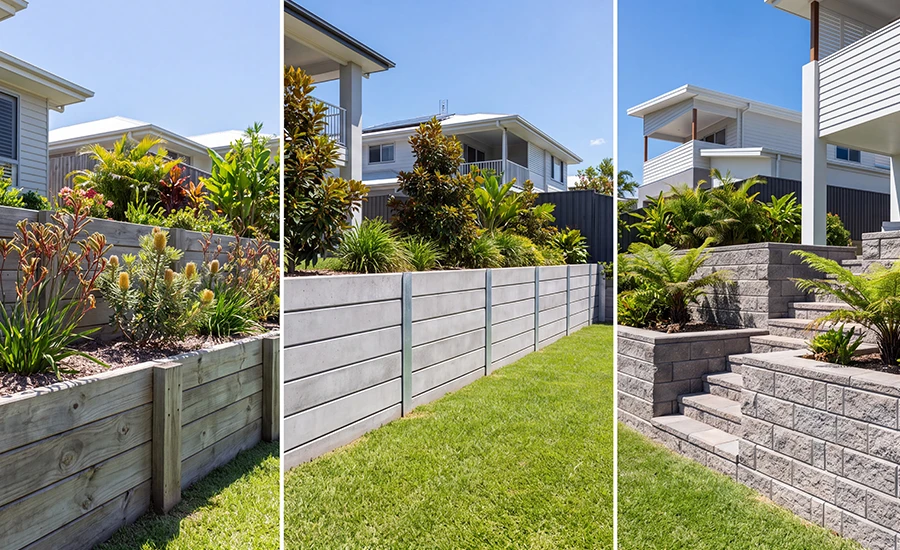
If you’ve ever seen a retaining wall lean, crack, or collapse outright, drainage is almost always the reason. Not the materials, not the builder, not bad luck. Water that had nowhere to go built up behind the wall, increased the pressure beyond what the structure was designed to handle, and eventually something gave way. Retaining wall drainage Sunshine Coast homeowners can rely on isn’t a finishing detail, it’s the thing the whole wall depends on, and it’s the part most homeowners never think to ask about until there’s a problem. And it doesn’t matter whether we’re talking timber retaining walls, concrete block or stone retaining walls. The best retaining walls factor in drainage and soil erosion to create a sound structure that will stand the test of time.
Why Retaining Wall Drainage Sunshine Coast Matters
A retaining wall is holding back soil. That soil absorbs water. When it rains heavily, as it does regularly on the Sunshine Coast, that soil becomes saturated and significantly heavier. The wall now has to resist not just the weight of dry soil but the combined pressure of wet, waterlogged ground pushing against it from behind the wall.
Without proper drainage to relieve that pressure, the load builds every time it rains. Over months and years, that repeated stress works on the footings, the posts, and the wall face until something moves. A wall that looked fine for three years can develop a visible lean almost overnight after a wet season on the Sunshine Coast. Drainage issues are rarely dramatic at first. They build quietly until they aren’t quiet anymore.
What Proper Retaining Wall Drainage Sunshine Coast Involves
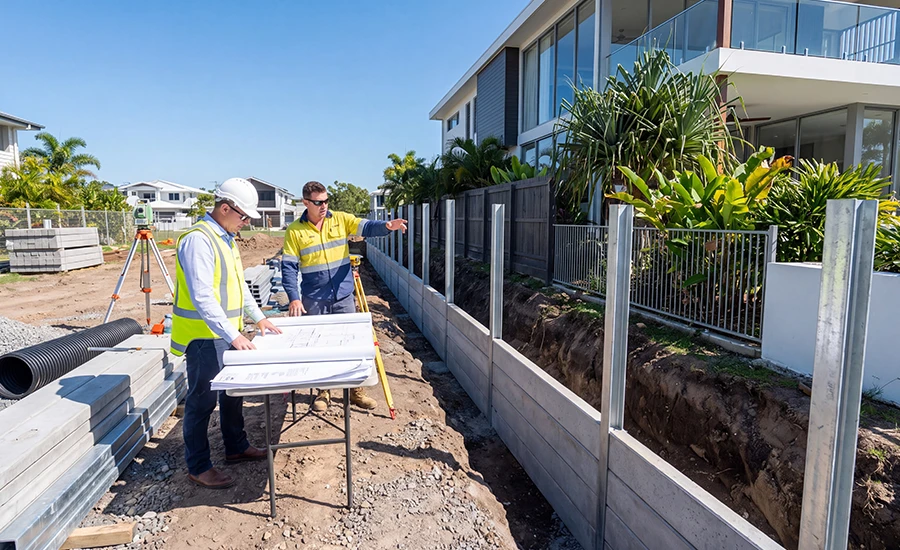
Good drainage behind a retaining wall has to be built in from the start. You never want to find yourself in a position where you have to engage retaining wall builders to retrofit drainage to an existing retaining wall. It is possible but it’s expensive and disruptive. Getting it right during construction costs very little by comparison.
The Drainage Layer Behind a Retaining Wall
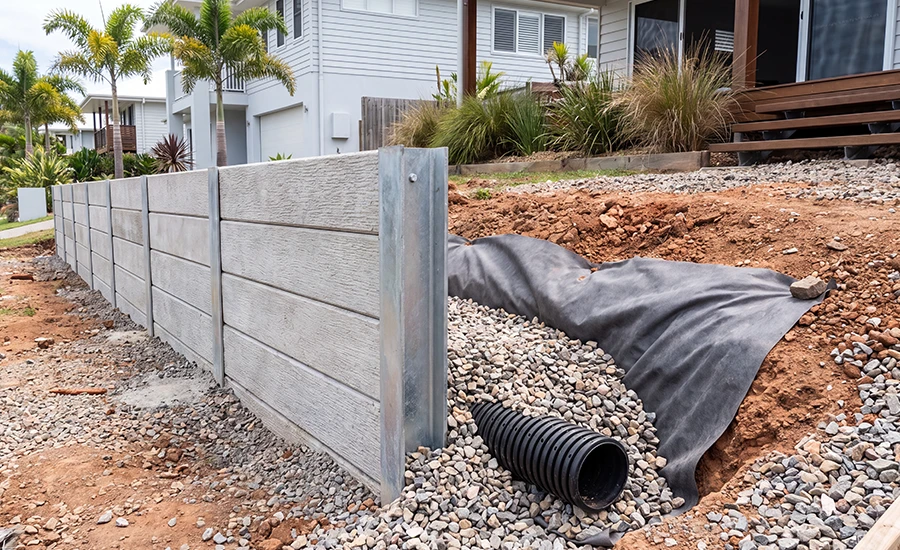
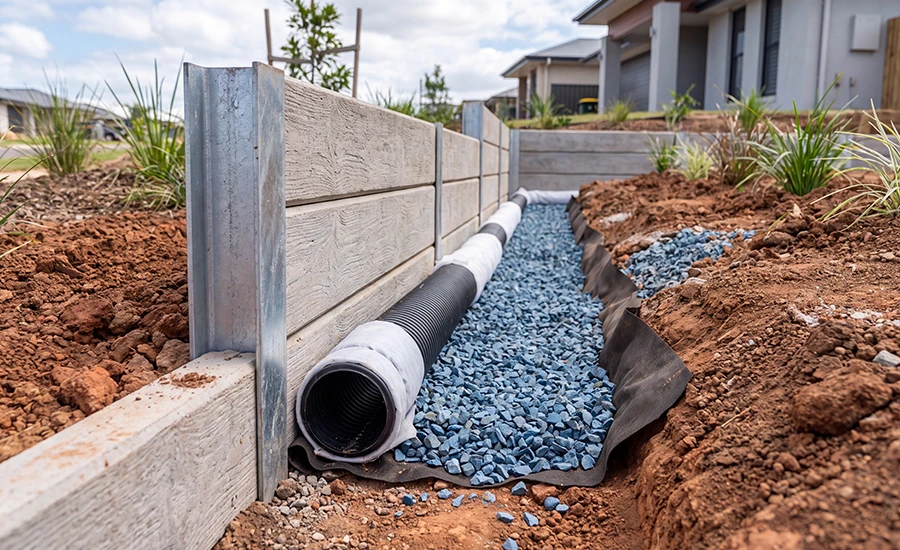
Directly behind the wall, the backfill material should be coarse and free-draining rather than compacted clay or garden soil. Gravel or crushed rock allows water to move freely downward rather than sitting against the back of the wall where it builds pressure. This layer is the foundation of proper drainage and the step most often skipped on budget jobs.
Ag pipe and outlets
At the base of that drainage layer, an agricultural drain pipe collects water and carries it away to a safe outlet point. Without a proper outlet, the drainage layer simply becomes a reservoir. The outlet location matters too: it needs to discharge water away from the base of the wall, not back toward it.
Weepholes, small gaps left in the wall face at regular intervals, provide a secondary release point for any water that builds up. You’ll see these in concrete sleeper walls and block walls as small openings near the base. They’re not decorative and they’re not optional.
Warning Signs That Drainage Has Already Failed on an Existing Retaining Wall
If you have an existing retaining wall on your Sunshine Coast or Gold Coast property, these signs are worth taking seriously:
A wall that is visibly leaning or bowing outward is under pressure it wasn’t designed for. Horizontal cracks across the face of a concrete sleeper wall or block wall suggest the structure is flexing under load. Soil appearing at the base on the downhill side can indicate material is being carried through by water movement. Efflorescence, the white chalky deposits that appear on masonry surfaces, is caused by water moving through the wall and depositing minerals as it evaporates. It’s not immediately dangerous, but it tells you water is passing through rather than draining away properly behind the wall.
Any of these signs on an existing retaining wall is worth getting a professional eye on before the next wet season. A wall showing distress will generally continue to deteriorate; the question is how quickly.
Where Retaining Wall Drainage Goes Wrong on Sunshine Coast Properties
A few patterns come up repeatedly across local properties, and they’re worth knowing about whether you’re building new or assessing what you’ve already got.
The first is inadequate backfill. A concrete sleeper wall or timber sleeper wall built with the excavated clay backfilled directly behind it has no drainage layer at all. The soil compacts against the wall, holds water, and the pressure builds from the first decent rain.
The second is missing or blocked ag pipe. It can be omitted entirely on lower-budget jobs, or installed but never connected to a proper outlet. Pipe that terminates in the backfill is no better than no pipe. Roots can also infiltrate ag pipe over time and block it, which is why accessible inspection points are worthwhile on older walls.
The third is poor site drainage generally. A retaining wall that sits at the base of a slope or receives runoff from paving, rooflines, or neighbouring properties is dealing with more water than a standard wall. The drainage design needs to account for that additional load, not just the soil immediately behind the wall.
On the Sunshine Coast, where a single afternoon storm can deliver 50mm or more in a short window, these factors matter more than they would in a drier part of QLD. A drainage solution adequate in Brisbane can be overwhelmed here during summer.
FAQ
Does every retaining wall need drainage?
Yes, in practice. Even low walls in well-draining soil benefit from some provision for water management. For walls over about 600mm, or any wall on a sloping block or in an area with heavy seasonal rainfall, proper drainage is not optional if you want the wall to perform across its design life. Queensland’s wet season makes this more critical than in most other parts of Australia.
How do I know if my existing retaining wall has drainage?
If the wall was built with weepholes visible in the face, that’s a reasonable sign drainage was considered. Beyond that, it’s difficult to know without inspecting what’s behind the wall. If it was built as part of a basic landscaping job rather than by a retaining wall specialist, it’s worth having it assessed, particularly if it’s over a metre high or on a slope.
Can drainage be added to an existing retaining wall?
It can, but it’s not straightforward. In most cases regardless of type of retaining wall, you will have to excavate behind the wall, install a drainage layer and ag pipe, and reinstate the backfill. Depending on the wall type and height, your poorly draining wall may also require temporary bracing. It’s significantly more expensive than building proper drainage in from the start, which is the strongest argument for getting it right the first time.
What is the white substance appearing on my retaining wall?
That’s efflorescence, caused by water moving through the wall material and leaving mineral deposits on the surface as it evaporates. It’s a sign that water is passing through the wall rather than draining away behind it. It won’t cause immediate structural damage but it does indicate a drainage issue worth investigating, particularly if the wall shows any signs of movement.
How long should a retaining wall last on the Sunshine Coast?
A well-built wall with proper drainage should last twenty to thirty years or more depending on retaining wall materials. Concrete sleeper walls with good drainage are among the most durable options in this climate. Timber sleeper retaining walls in contact with poorly draining soil are at the shorter end of the lifespan range. Drainage is the single biggest variable in how long any wall actually lasts, regardless of what it’s built from.
Build the Drainage Right and the Wall Will Look After Itself
The walls that fail are almost never the ones where drainage was properly thought through. They’re the ones where it was skipped to save a few hundred dollars, or simply never discussed. On the Sunshine Coast, where the rainfall is real and the wet seasons are genuine, a retaining wall without proper drainage behind it isn’t a question of whether it will cause problems… it’s a question of when.
If you’re planning a new retaining wall or looking at an existing retaining wall that’s showing signs of distress, a conversation with someone who builds these properly is worth having before the next summer arrives. That’s exactly what we do at Greener Landscaping across the Sunshine Coast and Gold Coast.
Call Greener Landscaping on 07 4120 7807 for a free quote.