It’s one of the more common questions homeowners on the Sunshine Coast wrestle with when they’re planning a new garden: do you build raised gardens, or do you work with the ground you’ve got? Both approaches have genuine merit, and the right answer isn’t the same for every property. What is consistent is that Queensland’s climate and soil conditions make this decision more consequential here than it would be in most other parts of Australia.
Raised Garden Beds vs In-Ground Gardens: What Are You Choosing?
The choice between raised garden beds and in-ground planting isn’t just about aesthetics or budget. It’s a decision about how much control you want over your growing environment, how your property drains, what your existing soil is like, and what you plan to grow. Get those factors clear first and the right approach usually becomes obvious.
Why Raised Garden Beds Work Better in Queensland Soil and Drainage
For most residential properties on the Sunshine Coast and Gold Coast, raised gardens offer practical advantages that are hard to argue with.
Soil Control Benefits of Raised Garden Beds
The single biggest advantage of a raised garden bed is that you choose what goes in it. You’re not fighting compacted fill, heavy clay soils, or nutrient-poor subsoil. And let me tell you, those are problems that are extremely common on newer Sunshine Coast developments: where topsoil has been scraped during construction and the ground left behind is more suitable for a carpark than a vegetable garden.
With a quality soil mix designed for your growing goals, a raised garden gives plants the best possible start regardless of what’s underneath. Soil quality is the foundation everything else depends on, and raised beds put that entirely in your hands.
Drainage Advantages of Raised Garden Beds in Queensland
Queensland’s wet season can be relentless. In-ground beds on properties with heavy clay soils or poor drainage turn waterlogged quickly, and most plants don’t tolerate saturated root zones for long. Proper drainage in a raised garden bed keeps roots in the right conditions even during heavy rainfall events, which on the Sunshine Coast can mean significant water in a short window.
This is particularly relevant across the hinterland and coastal areas where soil profiles vary enormously from one street to the next.
Practical advantages that add up
Raised gardens are easier to maintain. They reduce the need to bend, they warm up faster which extends the growing season into cooler months, and they create a physical barrier against some ground-level pests and weed seeds. For older gardeners or anyone with mobility considerations, that accessibility factor alone can make raised garden beds the clear choice.
Why Raised Garden Beds Work Better in Queensland Soil and Drainage
In-ground planting isn’t always the compromise option. In the right conditions it’s often the better one.
When your soil is already good
If your property has decent topsoil, reasonable drainage, and you’re not dealing with compaction or heavy clay soils, in-ground planting gives deep-rooted plants unrestricted root growth that no raised garden can match. Fruit trees, large shrubs, and many Australian native species perform better in ground than in any contained growing environment.
Cost and scale
For large garden areas, in-ground planting is simply more economical. Building enough raised gardens to cover the same area as a large in-ground vegetable garden is a significant investment. If the soil conditions support it, working with the ground rather than building above it makes financial sense.
Raised Garden Beds vs In-Ground Gardens in Sunshine Coast Climate
Southeast Queensland throws up a set of conditions that consistently favour raised garden beds for food production and structured planting.
Heavy clay soils are widespread, particularly in coastal lowland areas, and they drain poorly and compact easily under rainfall. Newer estates across the Sunshine Coast and Gold Coast frequently have construction fill near the surface where topsoil was removed during development. Summer rainfall intensity means that even reasonable soil can become waterlogged quickly if drainage isn’t well managed. Warm soil temperatures year-round accelerate the breakdown of organic matter in in-ground beds, meaning you need to replenish more frequently than in cooler climates.
None of these problems are insurmountable in an in-ground garden, but they all require ongoing remediation. A raised garden sidesteps most of them by design, and for a vegetable garden or kitchen garden where soil quality directly affects what you harvest, that head start matters.
Combining Both Approaches
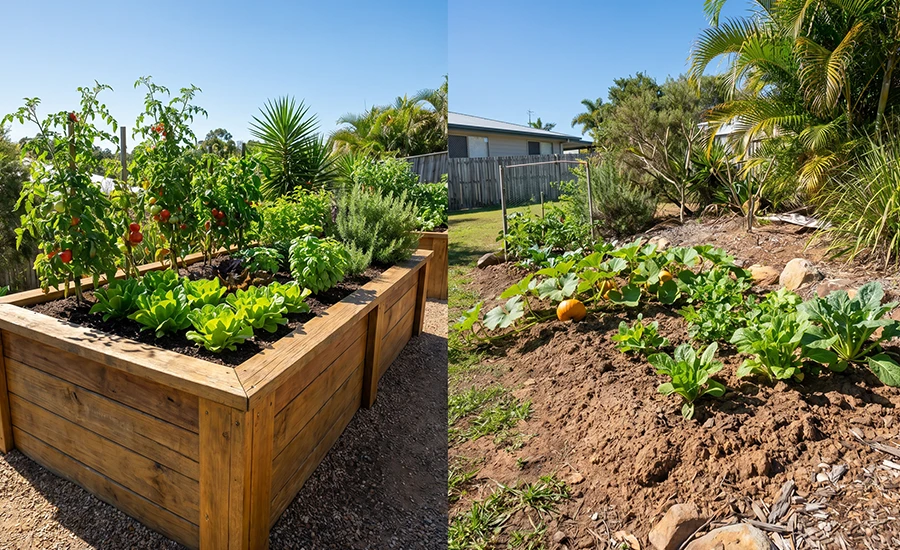
The most practical gardens on the Sunshine Coast often use both. Raised gardens for vegetables, herbs, capsicum, leafy greens, and structured planting close to the house; in-ground planting for larger ornamentals, native species, and areas where the soil is good and scale makes raised construction impractical.
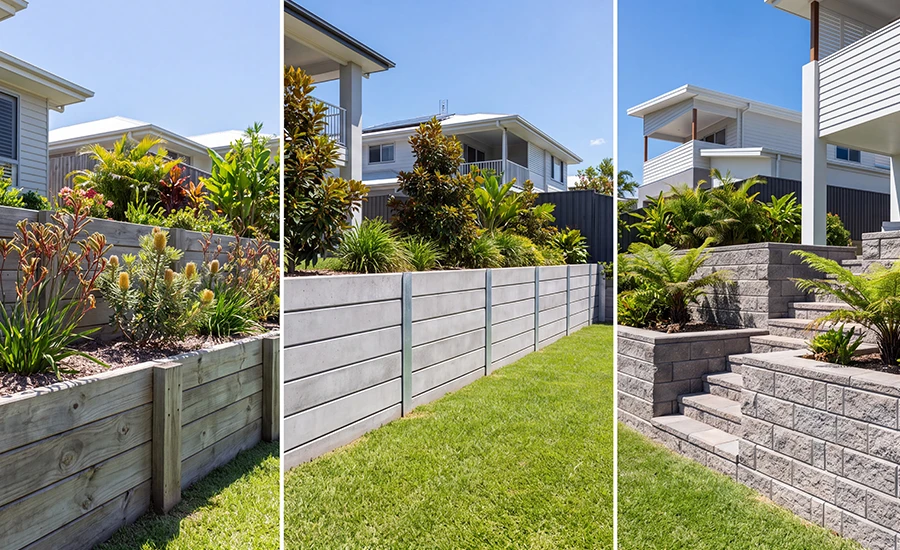
On sloping blocks, raised garden beds work naturally alongside retaining walls to create tiered, usable spaces that would otherwise be awkward and hard to maintain. The retaining walls manage the level changes, and the raised beds turn those platforms into productive growing space with proper drainage built in from the start.
FAQ
Are raised gardens worth it in Queensland?
For most Sunshine Coast and Gold Coast properties, yes. The combination of variable soil quality, heavy seasonal rainfall, and construction fill on newer developments makes raised gardens a more reliable starting point for food production than in-ground alternatives. The upfront cost is higher, but the results are more consistent and the growing season is easier to manage.
What vegetables grow best in raised garden beds in Queensland?
Most vegetables perform well in raised gardens in Queensland, particularly leafy greens, herbs, tomatoes, capsicum, beans, and brassicas. Root vegetables like carrots need deeper beds (at least 450mm) to develop properly. The warm year-round climate on the Sunshine Coast means you can grow a wider range of produce across more months than most other Australian gardeners can manage.
How do raised gardens handle Queensland’s wet season?
Better than in-ground beds in most cases, provided they’re built with proper drainage. A drainage layer of coarse gravel or scoria at the base keeps the root zone from becoming waterlogged during heavy rainfall. Raised beds built without that layer are vulnerable to the same poor drainage problems as in-ground beds on heavy clay soils.
Do raised gardens suit sloping blocks?
They suit sloping blocks very well, particularly when integrated with retaining walls as part of an overall landscaping plan. The walls manage the grade changes and the raised gardens make productive use of the flat platforms created. It’s one of the most effective ways to turn a challenging slope into a functional, good-looking garden with a genuine growing season year-round. Landscaping solutions for sloping blocks →
Can you convert an in-ground garden to raised beds?
Yes, and it’s often straightforward. Raised garden frames can be built directly over the existing in-ground area and filled with quality growing mix. Existing soil can sometimes be incorporated into the mix if it’s in reasonable condition and free of persistent weeds.
Which Garden Type Is Best for Your Queensland Block?
If you’re starting from scratch on a Sunshine Coast or Gold Coast property, raised gardens give you the most control over your growing environment and the most reliable results in Queensland conditions. If your soil is already good, your drainage works, and you’re planting at scale or with deep-rooted species, in-ground planting can be the more practical choice.
Most gardens end up using both. The key is matching the approach to the actual conditions on your block rather than defaulting to one or the other without thinking it through. If you’d like advice on what makes sense for your property… and how garden beds can work alongside retaining walls and your broader landscaping plan… then call Greener Landscaping on 07 4120 7807 for a free quote. We work across the Sunshine Coast, Gold Coast, and Brisbane every day.